
 Blog
 Social


Your School’s First Impression Is Doing the Talking

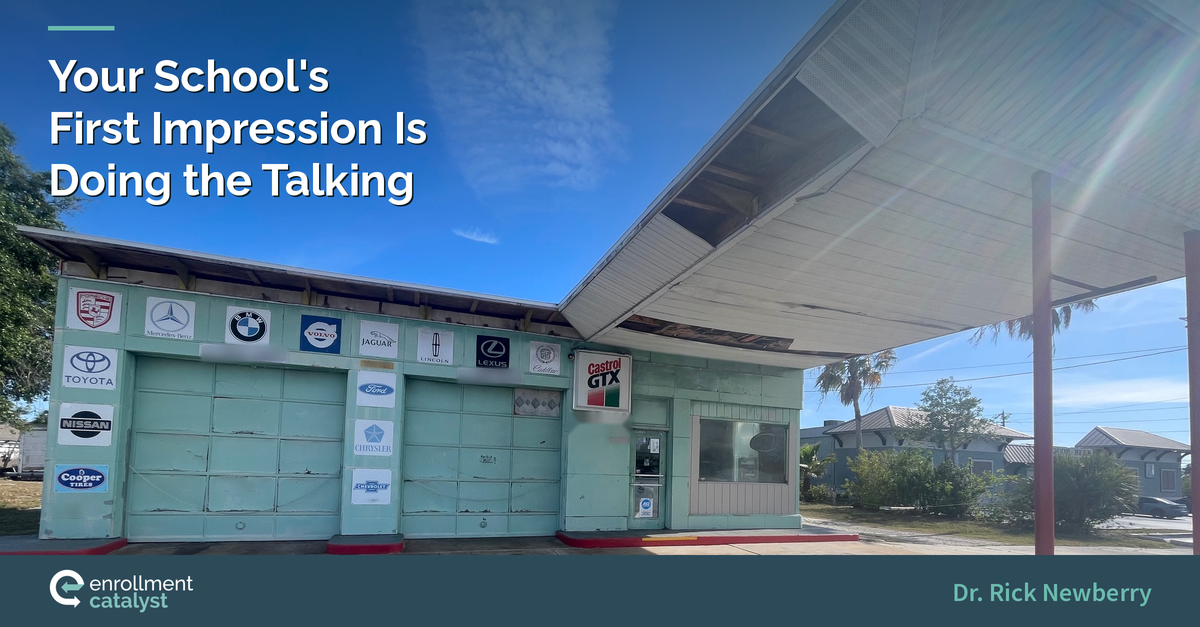 On my walks when I am home in Florida, I pass a car repair shop that always catches my eye. The building is a faded mint green with red trim, and the canopy over the old fuel pumps is sagging, with the underside peeling away. If you drove past at 40 miles per hour, you would assume it had closed years ago.
Then you notice the garage doors, which are lined with the logos of Porsche, Mercedes-Benz, BMW, Jaguar, Lexus, and Cadillac. The shop is telling the world that it services some of the finest cars on the road. The people inside may be skilled, honest, and fairly priced. I have no way of knowing, and neither does anyone else who drives by. I suspect most owners of cars like those simply keep driving, and the shop never finds out how many of them there were.
That image has stayed with me because it describes something I see in schools. What would a family conclude about your school if the building, the website, and the first email were all they ever experienced?
Parents Decide Before They Ever Visit
Most school leaders think of the tour as the moment their story begins. The classroom visit, the conversation with a teacher, the meeting with the principal: that is where the mission comes alive, and it is where schools are at their best.
The difficulty is that many families never get that far. A parent’s first contact with your school is rarely a person. It is more likely a website on a phone, a Google listing, a drive past campus, or a post a friend shared. It might even be a chat in AI. Each one is a small audition, and almost none of them are visible to you. A family that is unimpressed does not call to explain why. They quietly move on to the next option.
This matters most for the families who are the best fit for your mission. Parents who are thoughtful about choosing a school tend to compare several of them, and small details can tip the decision. If they never reach your classrooms, they never get to see what makes your school different.
Three Front Doors
I encourage school leaders to think about three front doors, because families pass through all of them before they ever sit across from an admissions director.
The first is digital. Your website, your mobile experience, your Google reviews, and your social media all tell a parent who you are. Can a visitor tell within a few seconds who you serve and what to do next? If the homepage is cluttered or slow on a phone, some families will leave without scrolling.
The second is physical. Your signage, entrance, parking lot, and landscaping set a tone before anyone steps out of the car. This has little to do with how new your buildings are. A modest campus that is clean, clearly marked, and obviously cared for says something very different from one with peeling paint and a confusing entrance.
The third is human. It is the first phone call, the first email, and the follow-up after an inquiry. A warm and timely response tells a family they matter. A slow or generic one tells them they are a form submission.
Consider a hypothetical example. A family drives past your school on a Saturday while running errands, and no one is on campus, so all they see is the sign and the building. That evening they search for your school and land on a website that has outdated and unimpressive content. They decide to look again later, and later never comes. Nothing about your faculty or your mission played any part in that decision.
When the Outside Does Not Match the Inside
What struck me about the repair shop was less its age than the gap. Plenty of excellent businesses operate from older buildings. But the logos made a promise that the building did not support.
Schools can create the same gap. Your mission statement may speak about care, community, and academic growth, and your teachers may deliver on all of it. But if the first thing a family sees does not match that promise, they may never get to the place where it is true. The stronger your experience is on the inside, the more it costs you when the outside lags.
None of this requires a major redesign or a capital campaign. It requires being intentional about what a parent sees and making sure it is consistent with what you say.
Walk Your Own Parking Lot
Here is something you can do this week. Pretend you are a parent who has never heard of your school.
- Search for your school on your phone and see what appears first.
- Click through your website and notice where you get confused or lose interest.
- Drive onto campus and see whether it is obvious where to park and where to enter.
- Call your main line at a random time and see who answers and how.
- Submit your own inquiry form and track how long a response takes and what it says.
At each step, ask where a family might stop. Then invite someone from outside your school to do the same. Those of us who work inside a school every day stop noticing what visitors see, and an honest outside view is worth more than our own assumptions.
Start Where Families Drop Off
You do not have to fix everything at once. A cleaner entrance, clearer signage, a simpler homepage, and a faster reply to inquiries can change how a family feels before anyone speaks to them. The key is knowing where families are actually leaving the process, so you invest in the right place instead of guessing. That takes honest research.
If you would like to see your school the way a new family does, my Online Secret Shopper Program is one way to find out.
The Question to Bring to Your Next Meeting
I do not know whether that repair shop is the best in my area. Its skills may be exactly what those owners are looking for, and they may never know it, because the building tells them not to stop.
So here is a question worth putting on your next leadership team agenda: if a family judged your school only by what they can see from the street and from their phone, what would they decide?
