
 Blog
Blog Social

Why Your School Needs a Word-of-Mouth Marketing Plan

 Whenever I work with a school, one of the questions I want to answer is, “How do families first hear about your school?” After conducting thousands of parent focus groups, surveys, and enrollment assessments over the years, the response is remarkably consistent: word of mouth.
A friend tells them about the school. They know a family whose children attend. Someone at church, work, in their neighborhood, or at their child’s soccer game recommends it. Today, parents will also search Google, read reviews, visit your website, scroll through social media, and increasingly use AI tools like ChatGPT to research and compare schools. But even with all of these new tools available, a recommendation from someone they know and trust continues to carry tremendous influence.
This is why I find it interesting that most schools don’t have a plan to drive more word of mouth.
Think about it. Your school probably has a strategic plan. You have plans for your academic programs, school improvement, and enrollment growth. You may spend thousands of dollars each year on digital advertising, your website, social media, print materials, and other marketing strategies.
But do you have a word-of-mouth marketing plan?
If word of mouth is one of your top inquiry sources, I believe it deserves the same intentionality that you give to your other enrollment and marketing strategies.
What Actually Drives Word of Mouth?
It would be easy to think that developing a word-of-mouth strategy simply means asking parents to refer their friends, write an online review, or become part of an ambassador program. All of these strategies can be effective, but I don’t believe they are the place to begin.
We first need to understand why a parent talks about a school in the first place.
Through my work with schools, I have identified nine drivers of word of mouth: Experience, Satisfaction, Quality, Passion, Loyalty, Trust, Service, Stories, and People. These drivers work together to create the conditions for positive word of mouth.
For example, every day your parents and students are having experiences at your school. These experiences influence their satisfaction and their perception of the quality of your school. Over time, positive experiences can build passion, loyalty, and trust. Exceptional service can create memorable moments, and those moments become stories that parents share with their friends.
Ultimately, word of mouth comes down to people. Your parents, students, faculty, staff, alumni, and others connected to your school are the ones having these conversations in your community.
This is why I have come to think of word of mouth as a system. The nine drivers are interconnected, and one weak area can have a significant impact on what parents say about your school.
Are You Giving Parents Something Worth Talking About?
One of the most important ideas in this framework is that advocacy is an outcome. Rather than starting with the question, “How can we get our parents to talk about our school?” I think we need to ask, “What are we doing that makes our parents want to talk about our school?”
That is a very different question.
If parents see their children thriving, experience a high-quality educational program, trust your leadership, feel valued by your faculty and staff, and have meaningful stories to tell, positive word of mouth becomes a natural result.
The reverse is also true. Parents will talk about poor experiences, weak service, broken trust, and unmet expectations. Word of mouth is happening whether we have a plan for it or not. Our opportunity as school leaders is to become more intentional about influencing it.
Join Me for The 9 Drivers of Word of Mouth
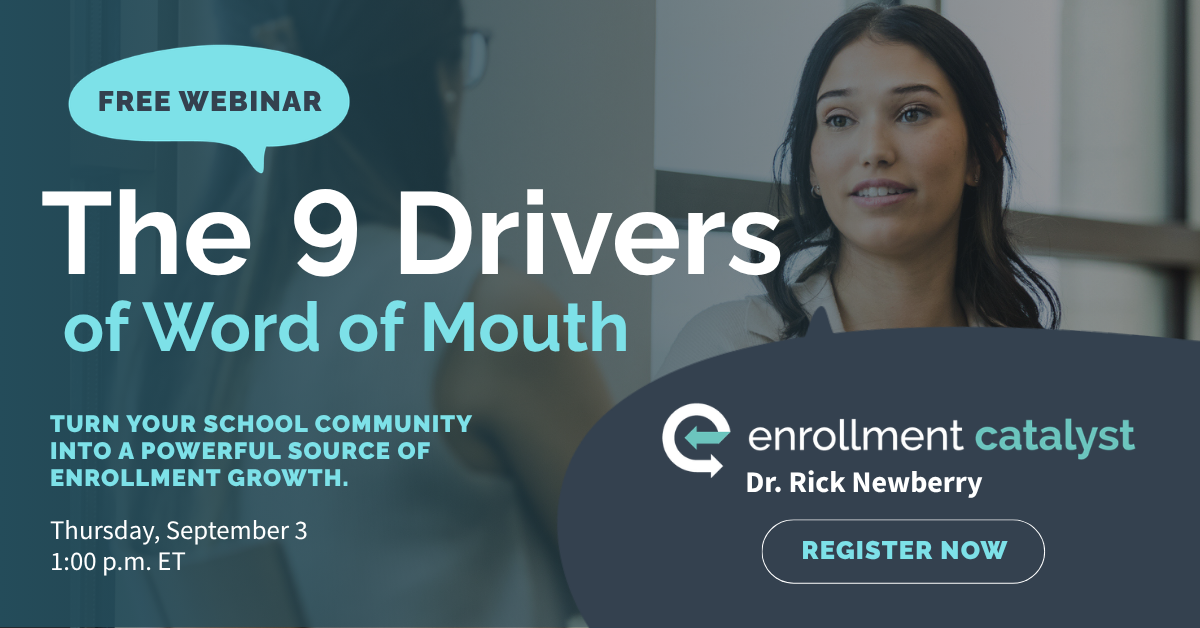
On Thursday, September 3, at 1:00 p.m. ET, I will lead a free webinar on The 9 Drivers of Word of Mouth. I will walk through each of these drivers, help you evaluate where your school is strong and where you may have gaps, and share practical ideas for developing a more intentional approach to word-of-mouth marketing.
If word of mouth is already one of the primary ways families discover your school, I believe it is time to stop treating it as something we simply hope will happen.
It is time to develop a plan.
I hope you will join me on September 3 at 1:00 p.m. ET..
