
 Blog
Blog Social

Revolutionizing Recruitment

 Why the Rules of Recruitment Have Changed
Over the past sixteen years, I’ve had the privilege of partnering with more than 500 private schools in 46 states, and a few outside of the U.S. I’ve walked campuses of every size, met with countless leadership teams, interviewed thousands of parents, and observed admissions offices during some of their best and most challenging enrollment seasons. Along the way, I’ve noticed something that has become increasingly difficult to ignore.
The schools that are thriving today are not necessarily the schools with the largest marketing budgets, the newest facilities, or even the strongest academic programs. While those factors certainly matter, they rarely explain why one school experiences sustained enrollment growth while another struggles to fill classrooms.
Instead, the difference is often found in something much less tangible. It is found in the experience families have as they search for a school and in the confidence they develop before they ever submit an application.
The rules of recruitment have changed.
Not because the timeless principles of enrollment have changed, but because the families we serve have changed.
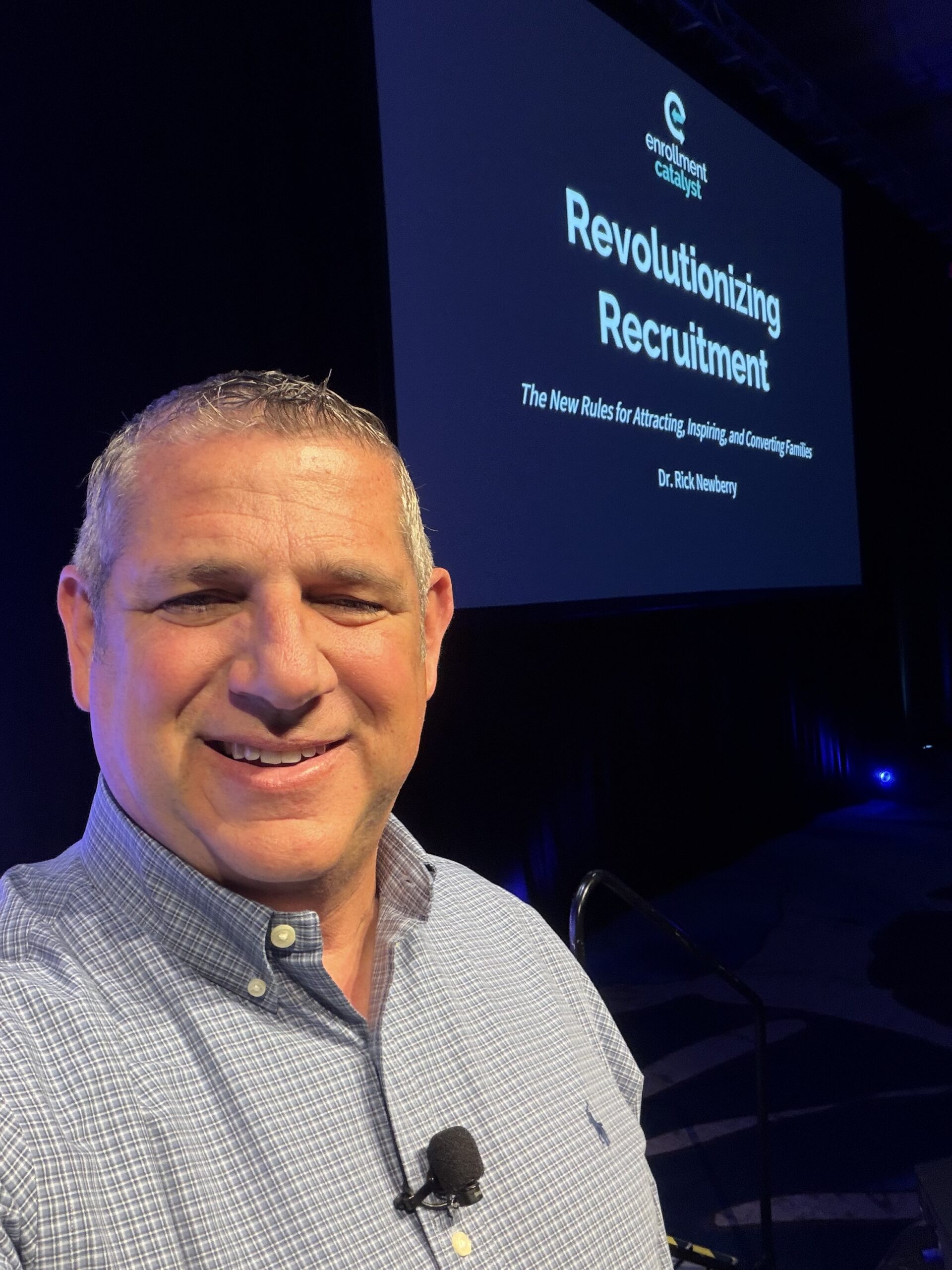
Recently, I had the opportunity to present this Keynote at FACTS Elevate in Orlando. This blog post, and this series, is an adaptation from my presentation.
Parents Are Making One of Life’s Most Important Decisions
Every prospective parent is trying to answer the same fundamental question:
Where will my child flourish?
It is an intensely personal question. Parents are not simply comparing academic programs or tuition rates. They are searching for a place where their child will be known, challenged, encouraged, and prepared for the future. They are looking for a community they can trust with one of their greatest responsibilities.
For many families, the school search is accompanied by excitement, uncertainty, hope, and even anxiety. They understand the significance of the decision they are making, and they want to get it right.
What has changed over the past few years is not the question parents are asking. It is how they go about finding the answer.
The Search for Schools Has Changed
For years, the enrollment journey followed a familiar pattern. Parents heard about a school through friends, searched Google, visited the school’s website, contacted the admissions office , and attended an open house.
Today, that journey looks very different.
Many parents now begin by asking an artificial intelligence platform such as ChatGPT a simple question:
“What are the best private schools near me?”
They quickly follow with additional questions.
“Compare these three schools.”
“Which one would you recommend?”
“What do parents like most about each school?”
Within a matter of minutes, they receive answers through summaries, comparisons, reviews, and recommendations that previously required hours of research. Whereas Google provides lists of links, AI gives an answer.
Artificial intelligence is undoubtedly changing the enrollment landscape. However, I believe many school leaders are focusing on the wrong issue.
Technology is not the biggest change.
Parents are.
Families have become more informed, more discerning, and more intentional than ever before. They have access to an extraordinary amount of information, yet they are searching for something that information alone cannot provide.
They are searching for confidence.
Information Is Abundant. Trust Is Rare.
One of the greatest misconceptions in enrollment marketing is that prospective parents simply need more information.
They don’t.
Parents have access to websites, videos, social media, online reviews, comparison tools, tuition information, academic data, and countless other resources. Information is no longer scarce.
Trust is.
The schools that consistently attract and enroll families understand this distinction. They recognize that recruitment is not primarily an information challenge. It is a trust-building process.
Information answers questions.
Trust gives parents confidence to make a decision.
Every email, every phone call, every campus visit, every conversation with a teacher, every interaction with the front office, and every story shared by another parent either strengthens that confidence or weakens it.
Recruitment, therefore, is not simply about communicating information. It is about intentionally creating experiences that build trust.
What Disney Taught Me About Recruitment
For much of my adult life, I have been fascinated by Walt Disney World.
I’ve visited the parks more than 400 times as an annual pass holder.
People often smile when they hear that number, but somewhere along the way I realized I wasn’t simply visiting Disney anymore.
I was studying it.
Why do millions of families willingly spend significant amounts of money, wait in long lines, and return year after year?
Why do they leave talking about the experience rather than the inconvenience?
The answer is often described as “Disney magic.”
I don’t believe it’s magic.
I believe it’s intentionality.
Every detail has been carefully considered. Every interaction has been designed. Every cast member understands that creating memorable experiences is just as important as operating attractions efficiently.
Disney understands something that every school leader should understand.
Extraordinary experiences rarely happen by accident.
They are intentionally designed.
The same principle applies to recruitment.
Great schools do not accidentally create exceptional admissions experiences. They thoughtfully design them, continually refine them, and consistently deliver them.
Recruitment Is Bigger Than Admissions
Many schools unintentionally define recruitment too narrowly.
They assume recruitment begins when a parent submits an inquiry.
In reality, recruitment begins long before the admissions office knows that family exists.
It begins when a current parent recommends the school to a friend.
It begins with an online review.
It begins with a Google search.
It begins when ChatGPT summarizes your school’s strengths and weaknesses.
It begins with your website, your social media, your reputation, and the stories your current families tell every day.
By the time a prospective family schedules a campus visit, they have already begun forming opinions about your school.
The admissions process doesn’t create those perceptions.
It either confirms them or changes them.
A New Lens for Recruitment
Throughout my career, I’ve become convinced that the foundational principles of enrollment remain remarkably consistent. Relationships still matter. Great experiences still matter. Stories still matter. Personal attention still matters.
What has changed is the urgency with which we must pursue them and the intentionality with which we design them.
In this series, I want to explore what I believe are eight timeless principles viewed through the lens of today’s enrollment environment. Together, they form a framework I call Revolutionizing Recruitment.
We’ll examine why relationships have become the new marketing, why experiences have become the true differentiator, why stories are more persuasive than statistics, why personalization has become an expectation rather than a luxury, and why intentional leadership sits at the center of every successful enrollment strategy.
The schools that thrive over the next decade will not necessarily be the schools with the biggest marketing budgets or the most sophisticated technology.
They will be the schools that understand people.
They will intentionally create trust, cultivate meaningful relationships, design memorable experiences, and communicate stories that help parents envision a flourishing future for their children.
Those schools won’t simply adapt to the changing landscape of enrollment.
They will help define it.
