
 Blog
Blog Social

Schools Don’t Have a LinkedIn Problem. They Have a Strategy Problem.

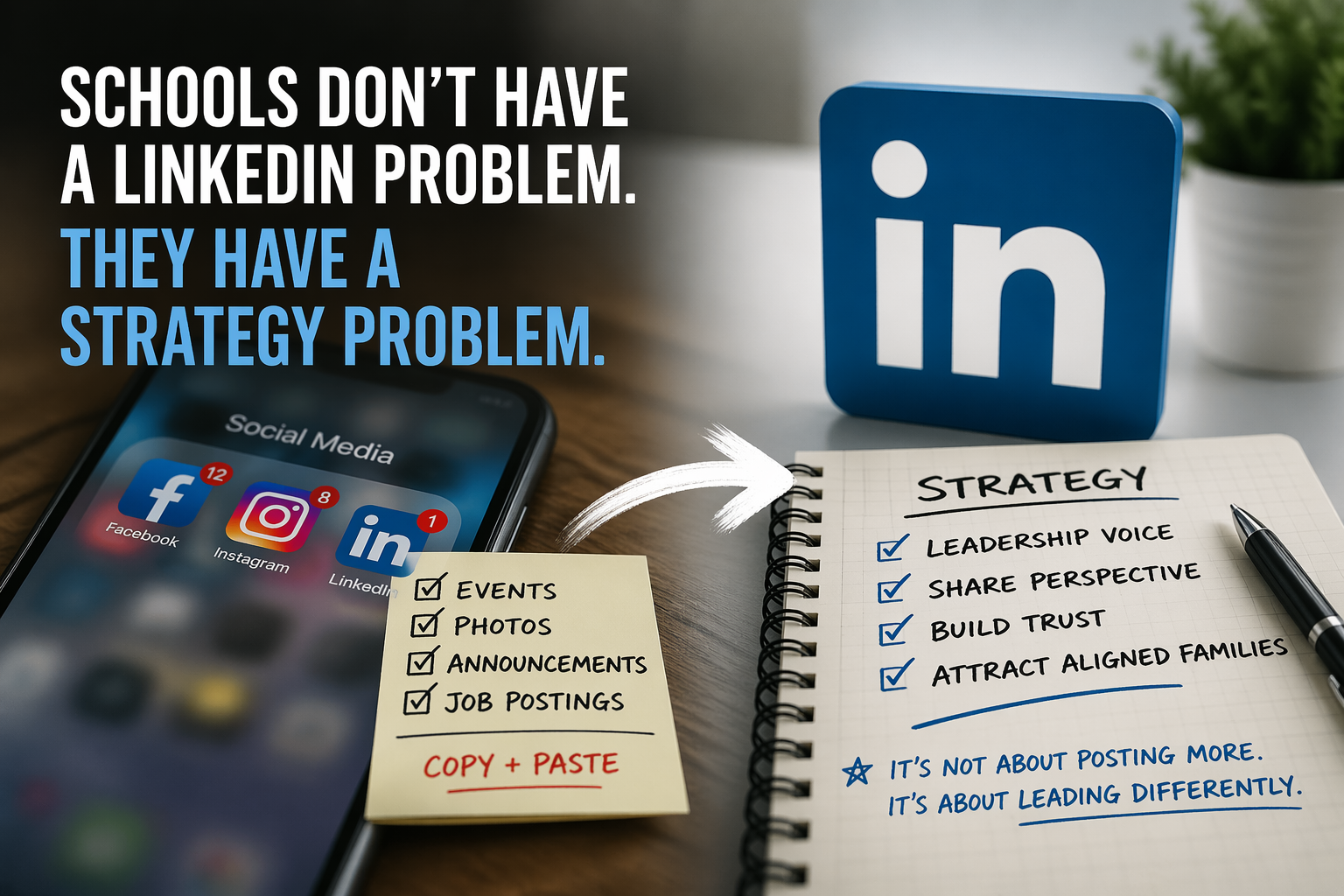
Why most private schools misunderstand LinkedIn and what to do differently
I’ve had a number of conversations recently with private school leaders about social media.
At some point, LinkedIn usually comes up.
And the responses tend to sound familiar.
“We have a LinkedIn page, but we’re not really sure what to do with it.”
“We post there occasionally, but it doesn’t seem to get much engagement.”
“We mostly just share what we’re already posting on Facebook and Instagram.”
So I decided to take a closer look at how schools are using LinkedIn.
What I saw was fairly consistent.
- Photos from events
- Student highlights
- Announcements
- Job postings
In many cases, the exact same content being shared on Facebook and Instagram.
There’s nothing wrong with any of that.
But it completely misses the point of LinkedIn.
Most Schools Don’t Have a LinkedIn Strategy
The bigger issue isn’t what schools are posting.
It’s that most schools don’t have a LinkedIn strategy at all.
They have an account. They occasionally post. But there’s no clear purpose behind it, no shared understanding of what success looks like, and no leadership guiding how the platform should be used.
And when there’s no clear purpose, something predictable happens.
Schools default to treating LinkedIn like every other social media platform. The content gets copied over, the tone stays the same, and the opportunity is quietly lost.
I’ve seen schools invest significant time and energy into social media, often with the help of strong resources and guidance from school marketing experts.
But LinkedIn is different.
This isn’t just about improving execution.
It’s about understanding what the platform is actually for.
LinkedIn Is Not Facebook for Schools
Facebook and Instagram serve an important role.
They help you showcase school life, celebrate students, build community, and tell stories in a visual and engaging way. For many schools, those platforms are the primary way families experience the day-to-day life of the school.
LinkedIn is different.
It’s not designed primarily for updates or event promotion. It’s a space where adults go to think, learn, evaluate, and observe leadership. People are paying attention to ideas, to perspective, and to how organizations communicate what they believe.
And here’s what’s important to recognize.
Many of the parents you most want to attract are spending time there, often in a very different mindset than when they are scrolling through other platforms.
LinkedIn Is a Leadership Platform
One of the simplest ways to understand LinkedIn is this:
It’s not primarily a marketing platform. It’s a leadership platform.
People aren’t just looking for information. They’re forming impressions about credibility, values, and alignment. They’re asking themselves, often subconsciously, “Do I trust how this organization thinks?”
As Simon Sinek has emphasized in his work, people are drawn to organizations that clearly communicate what they believe and why they exist. LinkedIn provides a consistent place for that kind of thinking to be visible over time.
The Problem With the School Page
Most schools approach LinkedIn through their institutional page.
And that page does matter. It provides a level of credibility, consistency, and a place to house important updates and stories. It serves as a digital front door for those who want to learn more.
But it’s not where the primary influence happens.
Because LinkedIn is built around people, not institutions. Engagement, trust, and visibility tend to follow individuals who share ideas and perspective, not logos that share announcements.
Where the Real Opportunity Is
The real opportunity on LinkedIn is through individual voices.
And in most schools, the most underutilized voice is the Head of School.
This is where the strategy begins to shift.
Instead of asking, “How often should we post?” a better question is, “What does our leadership voice sound like on LinkedIn?” That question moves the conversation from activity to purpose.
The Role of the Head of School
The Head of School is uniquely positioned to build trust in ways a school page cannot.
Not through promotion, but through perspective.
This might look like reflecting on a recent conversation with a parent, sharing thoughts on student growth, offering insight into what matters in education today, or explaining the reasoning behind a decision the school has made. These are not polished marketing messages. They are glimpses into how a leader thinks.
And that’s what people are paying attention to.
This isn’t about marketing the school.
It’s about showing how the school thinks.
A Critical Shift
Many schools assume the goal is to use LinkedIn to point people back to the school.
But that approach often feels forced and transactional.
A more effective approach is this:
Your leadership voice doesn’t point to the school. It embodies the school.
Over time, people don’t just see posts. They begin to understand your school through how you think, what you emphasize, and what you consistently come back to. That kind of clarity builds trust in a way that traditional marketing rarely can.
Expanding the Voice, Carefully
This doesn’t have to stop with the Head of School.
There is real opportunity to expand LinkedIn presence through a small group of aligned voices, including admissions leaders, academic leaders, and division heads. Each of these roles brings a different perspective and can help paint a fuller picture of the school.
But this only works with intentional alignment.
Without it, the message becomes inconsistent, and the impact is diluted. This is not just a social media issue. It’s a leadership alignment issue.
The goal isn’t more posting.
The goal is a consistent, mission-aligned voice that reflects how the school thinks and what it values.
Why This Matters for Enrollment
Families are forming impressions long before they ever inquire.
They’re paying attention to how a school communicates, what it emphasizes, and how its leaders talk about students, learning, and community. These signals begin to shape trust well before a campus visit is ever scheduled.
In many cases, alignment starts forming before a conversation even begins.
LinkedIn is one of the few places where schools can consistently demonstrate how they think, not just what they do. And for schools focused on mission-fit enrollment, that distinction matters more than ever.
A Simple Question to Consider
If a prospective parent followed your Head of School on LinkedIn for 30 days…
What would they learn about your school?
Not what you offer.
But how you think.
A Final Thought
Most schools don’t have a LinkedIn problem.
They have a clarity problem.
The opportunity isn’t to post more. It’s to think differently about what LinkedIn is for, and to lead it with intention rather than treating it as just another platform to maintain.
Because in a world where families are looking for trust and alignment, how you think matters just as much as what you offer.
Follow me on LinkedIn as I share though-leadership on enrollment marketing topics.
